22 October 2026

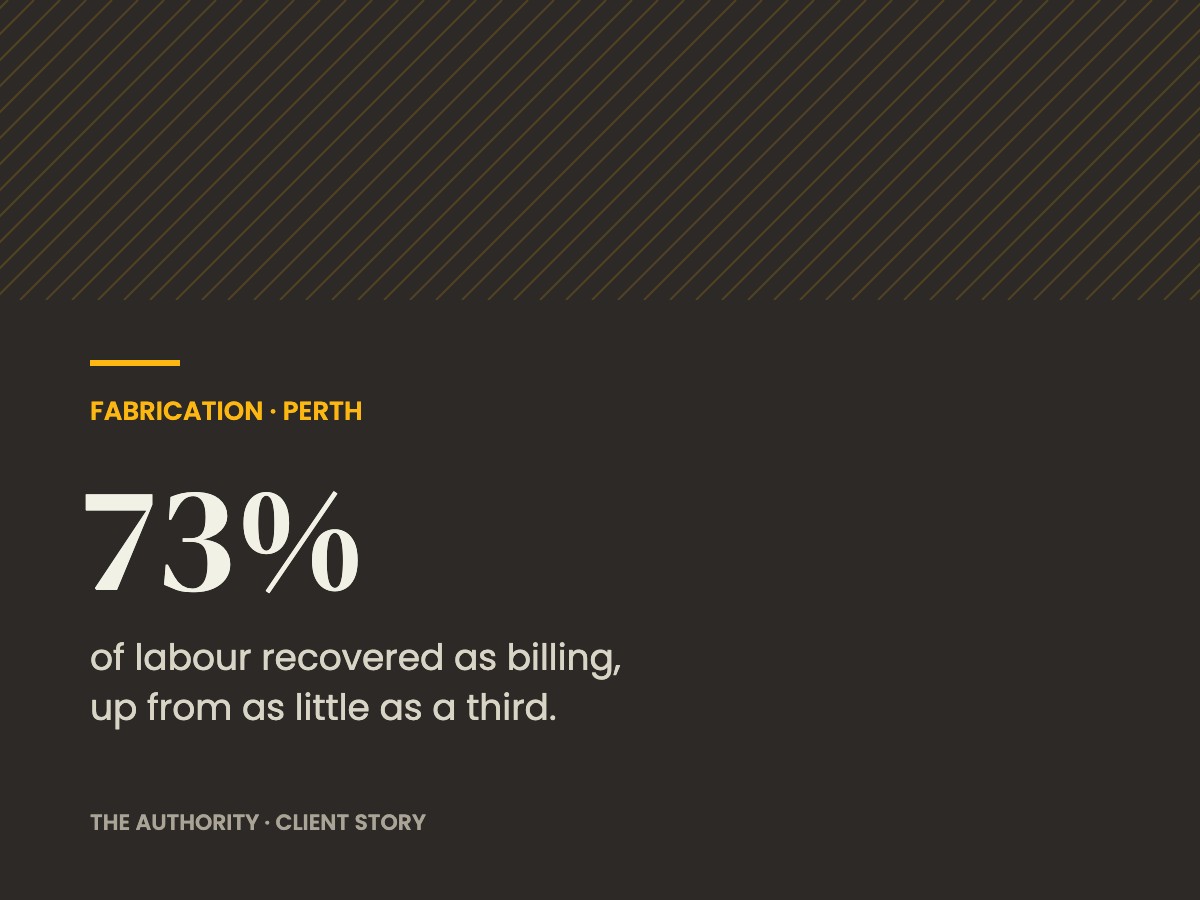
Fabrication case study: 73% of labour recovered as billing

22 October 2026

Fabrication case study: 73% of labour recovered as billing
Client story · Fabrication · Perth

“We don't even need to make any more money right now. We just need to stop losing money.”

How a fully booked fabrication shop found the money it was already earning, and raised its rate without losing a customer.

Labour recovered as billing
73%
in July, up from between a third and half of paid hours earlier in the year.
"Bevan" is a pseudonym. Details that could identify the business have been left out.
The owner
Bevan, owner of a family fabrication business
The business
Heavy fabrication: farm, civil and vehicle fit-outs
Team
Owner plus four trades
What we built
Recovery tracking, pricing, standards, process maps, review rhythm
The result

The leak got measured, the rate went up, and the work stayed.

73%
Labour recovered in July, against a 75 to 80% target
$147 → $166
Hourly rate, raised in steps over four months
0
Wrong parts "in weeks", in Bevan's words
14 days
To map the whole business and its core processes
The situation

Booked out, and going backwards.

The shop was full. Good customers, good reputation, work lined up.

And in one year it went from a 7% profit to a loss. Bevan had swapped unreliable subcontractors for his own staff, which was the right call. But wages jumped by about $146,000, and the extra hours never made it onto the invoices.

He was the bottleneck for everything, and he knew it.

I get three or four of these a day from the guys. Hey man, I need to cut these parts. So whatever I'm doing stops because they are now waiting for me.Bevan
The diagnosis

What he thought the problem was, and what it actually was.

What he thought

Quoting. Jobs were blowing out, and pricing them was the most stressful part of his week.

What it actually was

Recovery. When we matched clocked hours against billed hours, the business was billing between a third and half of the labour it paid for. The money was leaking after the work was done. Raising the rate wouldn't fix that on its own: you can't charge more for hours you never invoice.

What we did

Each step makes the next one cheaper.

June

Stop the leak first

A clocked-versus-billed reconciliation, cost centres and a job-margin tracker, so every job showed what it really made.

Margin & Recovery
June to September

Then price it

With recovery being measured, the hourly rate went up in steps rather than one jump.

Margin & Recovery
July

Set the standard

Quality before speed, a definition of a finished job, and set working hours with overtime cut back.

Foundation & Standards
August

Get it out of his head

A process map of the business, a five-stage fabrication process, a drafting process and an ownership map.

Ownership & Accountability
Monthly

Build a rhythm

Monthly reviews of the numbers, read live off the shop's own systems.

Reporting & Review Rhythm
Before and after

Four months in.

BeforeAfter
Labour recovered as billing34 to 49% a month73% in July
Hourly rate$147$166 to $167
Wrong partsRegular"Not in weeks"
Debtor daysNever measuredMeasured monthly
To be straight about it: monthly profit figures from this period were read live in sessions and aren't audited, so they're not on this page. And Bevan is still doing too much: the next hire hasn't been made, and some days still run late. One customer did ask for a discount after the rise. He was told no, and came back the next day at the full rate.
What's next

Now the floor needs to run without him checking every part.

The leak is mostly plugged and the standard is written down. The next job is the next leader, not more hours from Bevan.

Sound familiar?

Busy doesn't mean profitable. Sometimes it means the opposite.

If your shop is full and the bank account doesn't show it, start with a 15-minute call. We'll find where the hours are going.

Book a 15-minute Growth Audit15 minutes. No pitch deck. You'll leave knowing the one thing to fix first.
  • You're doing work you're not getting paid for.
  • You don't really know which jobs make money.
  • Price rises feel risky, so you don't make them.
  • Every question on the floor comes back to you.